
Resembling Rudyard Kipling’s elephant child with a ‘satiable curtiosity’, although I haven’t met my crocodile — yet, I ask ever so many questions and include everything and anything that turns out to be interesting. One tour is based around traditional spinning, dyeing and weaving. Sometimes there’s a concert with music by Puccini, a native son of Lucca. Since I’m posting this on Easter Sunday from a Catholic country, I’ll tell you about some of the churches in Lucca and the Garfagnana that I take my guests to see.
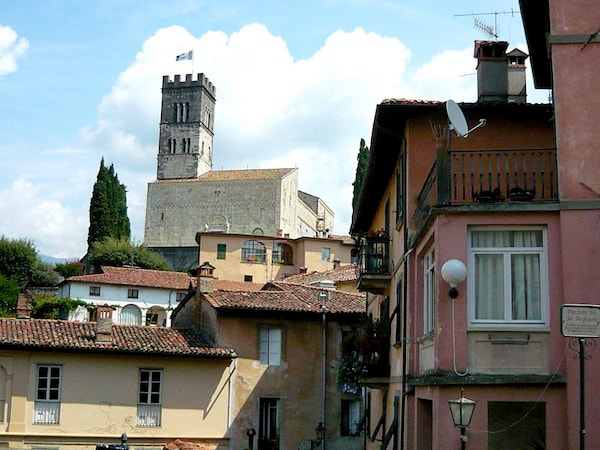
My all-time favourite is the duomo (cathedral) at Barga on the edge of the Garfagnana – see main picture. Parts of it date back to 1000 AD. Inside the hush is palpable. The wordless stones breathe tranquility and peace, and golden light seeps through the alabaster windows.

Alabaster windows
A magnificent marble pulpit stands alongside naive romanesque heads and inlaid figures.

Pulpit
A 3.5 m (11.5 ft) tall mediaeval carved wooden St Christopher with an undersized baby Jesus on his shoulder keeps guard over the whole church from his place in the apse. From the piazza in front of the church, you look over Barga and the Serchio River valley to the craggy Alpi Apuane opposite. Even though I’m not religious, I often go sit in this peaceful haven.

View from Barga duomo of the Alpi Apuane
Lucca has been called the ‘city of a hundred churches’. The Basilica of San Frediano stands out for its mosaic façade, the only one in Lucca.

San Frediano

Mosaic on façade of San Frediano
But what draws me there is one painting, one wooden statue and especially Santa Zita. Zita, a serving girl in a noble household, was a favourite of the family. However, she had a secret. Every evening she sneaked into the kitchen, wrapped the leftover bread in her apron and took it away to give to the poor. The other servants, being jealous, told their master she was stealing. He could hardly believe it. He waited for her one evening and challenged her to open her apron. She was very frightened but did as she was commanded and, by a miracle, in place of the bread, her apron was full of flowers. Her somewhat gruesome mummy, lying in a glass coffin in a side chapel, is redeemed by her blue servant’s dress, crisp white apron and the legend of her charity.

Santa Zita
If there isn’t a good story, I make one up. I’ve invented one about San Michele, in the Roman Forum of Lucca, and the duomo, San Martino. Ranks of decorated columns are stacked up their façades.

San Martino, Lucca

San Michele and Easter market
I like to imagine an annual column competition with the winner getting his (I expect there weren’t any female sculptors then) column added to the row. Maybe the runners up also got theirs up there, or else it would have taken an exceedingly long time to collect so many pillars. Of course I admit this as my own fantasy.

Columns of San Martino

Columns of San Michele
Perhaps this church in Villa Basilica, outside Lucca, with far fewer columns was the trial run for the column competition?

Duomo, Villa Basilica, during festival of paper
There are so many exquisite romanesque churches in the countryside I’m tempted to design a walking tour visiting them along with food and wine producers and restaurants on the route.
I wrote this blog on 8 April 2012 for another website. I’m pleasantly surprised that I still love these romanesque churches as much now as I did then. I’m sure you will too.
If you landed here by chance and would like to be notified of future posts, you can sign up here.
If you’d like periodic news about our tours and courses, sign up here.